Can the Bible mean whatever I think it means?

Can the Bible Mean Whatever I Think It Means?
Scripture doesn't become true because it agrees with what we feel.
People often say, "The Holy Spirit told me this verse means something different for me."
I believe the Holy Spirit speaks to people. The question is how we test what we think we heard.
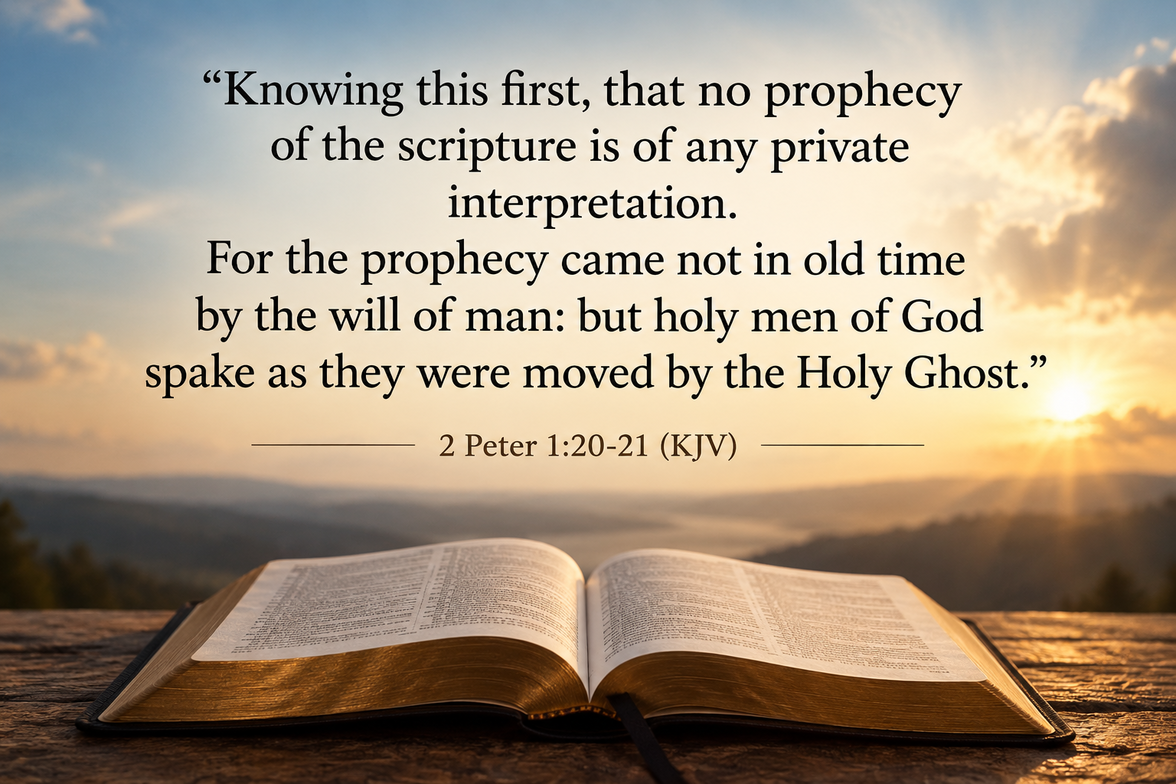
This passage begins with the source of prophecy. It didn't come by man's will.
Holy men spoke as they were moved by the Holy Ghost.
Peter, one of the twelve apostles, isn't saying that one verse settles every debate about interpretation. His point is that Scripture didn't begin as a private human idea, so we cannot treat it like raw material for whatever meaning we want.
I connected that to what another apostle named John says about the Holy Ghost and Jesus.
John 16 says:
"Howbeit when he, the Spirit of truth, is come, he will guide you into all truth: for he shall not speak of himself; but whatsoever he shall hear, that shall he speak: and he will shew you things to come."
John 16:13 (KJV)
Jesus says:
"Jesus saith unto him, I am the way, the truth, and the life: no man cometh unto the Father, but by me."
John 14:6 (KJV)
John begins his Gospel this way:
"In the beginning was the Word, and the Word was with God, and the Word was God."
John 1:1 (KJV)
Later in the chapter, he writes:
"And the Word was made flesh, and dwelt among us, (and we beheld his glory, the glory as of the only begotten of the Father,) full of grace and truth."
John 1:14 (KJV)
The Holy Ghost doesn't lead us away from the Scripture He inspired while claiming to explain it.
This doesn't mean every passage is easy or that sincere Christians will agree on every detail. Context still matters, and one meaning can have more than one application.
A passage about forgiveness may confront bitterness toward a family member. The same passage may expose resentment toward a friend.
The application changes, but the verse's meaning doesn't.
The problem begins when we say, "This is what God told me," and use that sentence to end every question.
Now there is no dialogue because nobody is allowed to ask where the thought appears in Scripture.
We need to be able to meet in the Word and say, "What does the passage actually say?"
That protects all of us, including the person teaching.
Our feelings are real, but real doesn't mean truth. An opinion can sound spiritual and still be wrong.
The Holy Ghost leads us to Jesus through Scripture. Claims made in His name can still be questioned and tested by the Word.
When we meet in Scripture, we finally have a standard higher than both of our opinions.
We may still need time and wise help to understand a hard passage. What we cannot do is make our feelings the final authority over what God said.
Here's how to test an interpretation:
1. Write down the claim.
Put the thought into one plain sentence. "I believe this passage means ____." A clear claim can be examined. A vague feeling cannot.
2. Read the passage around it.
The paragraph or even chapter before and after a verse gives us its immediate setting. If we are unclear about the writer or the original readers, the beginning of the book can provide that context before we decide what the passage means.
3. Let the Word correct you.
Bring the passage to your pastor or a mature Bible teacher. When your feeling and the text disagree, faith means receiving what God said.
PRAYER
Father God, keep me from using Your name to protect my own opinion.
Thank You for giving us Scripture and the Holy Ghost, the Spirit of truth.
When I feel certain, teach me to ask what the passage actually says.
Give me humility to receive correction when my interpretation came from me instead of Your Word.
Lead me through Scripture to Jesus, and make Your truth more important than winning an argument.
In Jesus' precious name we pray. Amen.